

Guides
The Science of Safety: Managing Cyanoacrylate Sensitivity in Lash Extensions (2026 Guide)
3 月
If you’ve been in the lash industry long enough, you’ve likely faced that dreaded moment: a client texts you two days after their appointment saying, “My eyes are swollen. Is this normal?”
In that instant, you transition from a lash artist to a crisis manager navigating safety, liability, and brand trust. This is why understanding Cyanoacrylate Allergy is no longer optional in 2026—it is the foundational knowledge required to build a sustainable lash business. At EZ-POP Beauty, we believe that professional performance is nothing without safety.
Why Cyanoacrylate Is Essential—and the Risk Factor
First, the hard truth: There is no professional lash adhesive without cyanoacrylate.
It is the backbone of modern lash retention. When exposed to moisture (even microscopic humidity in the air), it undergoes rapid polymerization, locking the extension to the natural lash instantly.
However, even a perfectly formulated adhesive can trigger sensitivity over time. This isn’t necessarily a product failure; it’s biology. At EZ-POP Beauty, we prioritize adhesive viscosity, humidity-stable curing, and low-fume dispersion to minimize these risks.
Note on Strip Lash Glue: Professional extension adhesive and DIY strip lash glue are NOT the same. Strip glues are often latex-based and designed for 8–12 hour wear. While extension allergies are often delayed 24–48 hours, strip glue reactions (usually due to latex or fragrances) appear almost immediately.
How the Body Develops a Cyanoacrylate Allergy
A cyanoacrylate allergy is typically a Type IV delayed hypersensitivity reaction. The immune system doesn’t always react the first time; it builds “memory.”
- Sensitization: A client can wear lashes for years without issues, then suddenly experience a reaction.
- The Snowball Effect: Once sensitized, each subsequent exposure typically becomes worse.
- Artist Risk: Professionals must also protect themselves from chronic inhalation, which can lead to rhinitis or dermatitis.
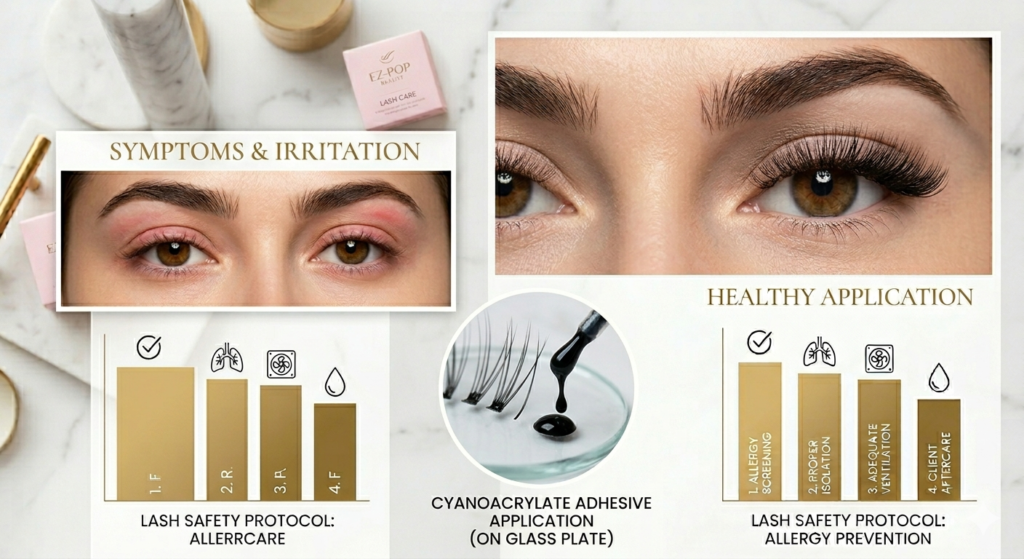
Identifying the Reaction: Irritation vs. Allergy
| Feature | Irritation (Mild) | Allergic Reaction (Serious) |
| Onset | Immediate / During appointment | Delayed (24–48 hours later) |
| Symptoms | Slight redness, mild watering | Intense itching, puffy/swollen eyelids |
| Duration | Resolves within hours | Worsens without removal |
| Cause | Fumes or eye pad placement | Immune system overreaction |
Prevention: The EZ-POP Beauty Standards
We believe prevention is a professional responsibility. To protect your clients and your business, follow these protocols:
- Adhesive Selection: Avoid “cheap” glues with unstable formulas. Look for transparency in ingredients and batch consistency.
- Environmental Control: Maintain a humidity range of 45–60% and temperature of 20–24°C. Incorrect humidity leads to “shock curing” and increased fumes.
- Technique Precision: Adhesive should bond to the hair, never the skin. Micro-dosing the glue reduces fume release significantly.
- Ventilation: Use carbon air purifiers and ensure proper airflow in your workspace.
What To Do If a Reaction Happens
- Stay Calm: Professionally remove the extensions using a high-quality remover. Never pull.
- Cold Compress: Apply to reduce inflammation.
- Medical Referral: If the client experiences vision changes or intense pain, refer them to a medical professional immediately.
Conclusion: Trust is the Ultimate Retention
The lash industry is evolving. Clients in 2026 are researching ingredients and asking for certifications. At EZ-POP Beauty, our philosophy is: Performance + Transparency + Education.
We don’t claim to be “100% hypoallergenic”—because that is scientifically inaccurate. Instead, we focus on optimized, stable formulations and honest education. Preventing one serious reaction doesn’t just protect a client’s eyes; it protects your career.
